High-Fiber Fruits for Gut Health: 16 Fruits Ranked by Fiber
Passion fruit is the runaway leader among high fiber fruits, with about 24.5 g of fiber in a cup of pulp. Nothing else comes close, and most adults eat only about 15 g of fiber in an entire day. This ranked list shows exactly where fruit can close that gap.
Every value below is standardized two ways: fiber per typical serving and fiber per 100 g. That dual basis matters, because high fiber fruits look very different depending on whether you eat a cup of them or a single piece. Rank by the serving you will actually eat.
The Fiber Chart
This chart is the whole argument for high fiber fruits in one view: fiber per typical serving and per 100 g, ranked honestly.
| Rank | Fruit | Serving | Fiber per serving | Fiber per 100 g |
|---|---|---|---|---|
| 1 | Passion fruit | 1 cup pulp (236 g) | 24.5 g | 10.4 g |
| 2 | Avocado | 1 whole fruit (150 g) | 10.0 g | 6.7 g |
| 3 | Guava | 1 cup (165 g) | 8.9 g | 5.4 g |
| 4 | Raspberries | 1 cup (123 g) | 8.0 g | 6.5 g |
| 5 | Blackberries | 1 cup (144 g) | 7.6 g | 5.3 g |
| 6 | Pomegranate | 1 cup arils (174 g) | 7.0 g | 4.0 g |
| 7 | Persimmon | 1 fruit (168 g) | 6.0 g | 3.6 g |
| 8 | Pear | 1 medium (178 g) | 5.5 g | 3.1 g |
| 9 | Kiwi | 1 cup sliced (180 g) | 5.4 g | 3.0 g |
| 10 | Dried figs | 3 figs (about 50 g) | 5.0 g | 9.8 g |
| 11 | Dragon fruit | 1 cup cubed (about 180 g) | About 5.0 g | 3.0 g |
| 12 | Apple | 1 medium with skin (182 g) | 4.5 g | 2.4 g |
| 13 | Blueberries | 1 cup (148 g) | 3.6 g | 2.4 g |
| 14 | Prunes | 5 prunes (about 47 g) | 3.3 g | 7.1 g |
| 15 | Orange | 1 medium (131 g) | 3.1 g | 2.4 g |
| 16 | Banana | 1 medium (118 g) | 3.1 g | 2.6 g |
A printable version of this chart turns the list into a shopping tool. Print it for the fridge or save it to your phone. Then use the sample day further down to see how two or three servings stack up.
How Much Fiber You Need Each Day
The standard guideline is about 14 g of fiber per 1,000 kcal eaten. In practice that means roughly 25 g a day for women and 38 g a day for men. Most adults land near 15 g, so the average reader of this page is running a daily deficit of 10 to 20 g.
Fruit alone will not close that gap, and it does not have to. Two or three servings of high fiber fruits can supply 10 to 20 g, and vegetables, beans, and whole grains supply the rest. Our master list of the best high fiber foods ranks fiber sources across every food group.
Here is what a fruit-forward day looks like in practice:
| Meal | Fruit serving | Fiber |
|---|---|---|
| Breakfast | 1 cup raspberries over yogurt or oats | 8.0 g |
| Snack | 1 medium pear, skin on | 5.5 g |
| Lunch | 1/2 avocado in a salad or sandwich | 5.0 g |
| Dessert | 2 kiwis | 4.2 g |
| Fruit total | About 23 g |
That is roughly 23 g of fiber from fruit alone, before a single vegetable or grain is counted. Most people find it easier than they expected. The trick is choosing high fiber fruits from the top of the chart instead of the bottom.
The 16 Highest Fiber Fruits, Ranked
The 16 high fiber fruits below are ranked by fiber per typical serving, the amount you would actually eat. The per-100 g values sit in the chart above for anyone comparing foods weight for weight.
1. Passion Fruit
Passion fruit is in a league of its own: 10.4 g of fiber per 100 g and about 24.5 g in a cup of pulp. The edible seeds carry much of that fiber, along with the pulp. Stir it into yogurt, spoon it over oatmeal, or eat it straight with a spoon.
2. Avocado
Avocado finally takes its proper place in this list, after years of sitting in the old version’s FAQ. One whole fruit delivers about 10 g of fiber, and half a fruit still gives you 5 g. Among high fiber fruits it is also the most versatile, working in salads, sandwiches, smoothies, and guacamole. For the carb side of the story, see our low carb fruits ranked by net carbs.
3. Guava
Guava provides 5.4 g of fiber per 100 g and about 8.9 g per cup, skin and seeds included. Eat it just ripe, when the skin is still firm enough to hold everything together. Guava is also one of the richest common sources of vitamin C.
4. Raspberries
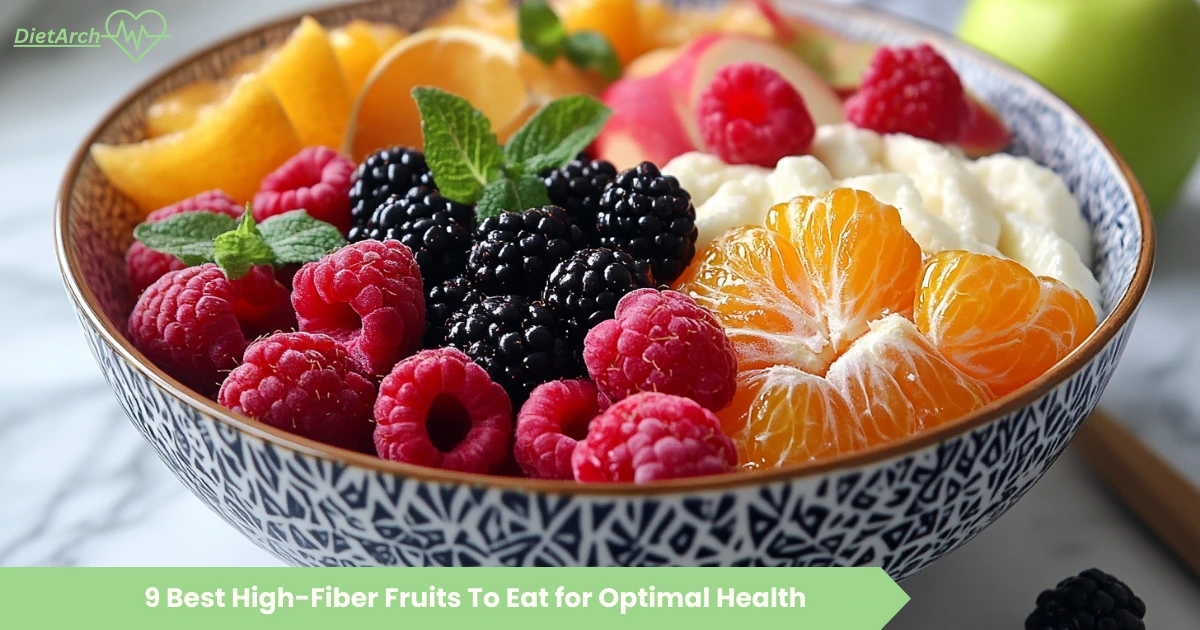
Raspberries deliver 8.0 g of fiber per cup, the best fiber return of any berry. Their tiny seeds are concentrated fiber, which is why raspberries beat bigger, juicier berries on this chart. They are also the easiest of the high fiber fruits to add daily, fresh over breakfast or frozen in smoothies.
5. Blackberries
Blackberries give 7.6 g of fiber per cup and 5.3 g per 100 g, nearly matching raspberries. Their seeds and skin do the work, so eat them whole rather than strained into sauces. A cup of mixed raspberries and blackberries is the simplest fiber upgrade in this article.
6. Pomegranate
A cup of pomegranate arils provides about 7.0 g of fiber, and a whole fruit holds about 11.3 g. You eat the seeds inside each aril, which is where the fiber lives, so do not strain pomegranate into juice if fiber is your goal. Scatter arils over salads, grain bowls, and yogurt.
7. Persimmon
One persimmon fruit carries about 6.0 g of fiber, an unusually high return for a single piece of fruit. Eat fuyu persimmons crisp like an apple, or let hachiya types soften fully before spooning them. Under-ripe astringent persimmons are unpleasant, so ripeness matters here more than for most fruit.
8. Pear
A medium pear with its skin on gives about 5.5 g of fiber. Pears are rich in sorbitol as well as fiber, a combination that gently supports regularity. Keep the skin on, because peeled pears lose a meaningful share of both fiber and polyphenols.
9. Kiwi
Kiwi provides 3.0 g of fiber per 100 g and 5.4 g per cup sliced. Its actinidin enzyme also helps protein digestion, which is why kiwi before a heavy meal is a traditional digestive trick. You can eat the fuzzy skin too, washed, for extra fiber.
10. Dried Figs
Dried figs concentrate fiber to 9.8 g per 100 g, so just three figs give about 5.0 g. The trade-off is concentrated sugar in a small package. Treat figs as a measured snack or a chopped topping, not a food to eat by the handful.
11. Dragon Fruit
Dragon fruit sits mid-table at about 3.0 g of fiber per 100 g and roughly 5.0 g per cup cubed. Its tiny black seeds supply much of that fiber. Earlier versions of this page overstated the per-cup figure, so the corrected value here is the one to trust.
12. Apple
A medium apple with skin provides about 4.5 g of fiber, much of it pectin. Apples are the most available of all high fiber fruits, which counts for a lot in real diets. Eat them unpeeled, because the skin and the flesh just under it carry the pectin.
13. Blueberries
Blueberries are modest on fiber at 3.6 g per cup, and they earn their place here on combined value. Their anthocyanin content is exceptional, as our guide to blue fruits and vegetables details. Think of blueberries as the fruit you eat for your brain that also contributes some fiber.
14. Prunes
Five prunes give about 3.3 g of fiber, plus sorbitol, which draws water into the bowel and softens stool. That one-two effect is why prunes outperform many fruits for constipation in clinical comparisons. A small daily serving is a gentle, food-first place to start.
15. Orange
A medium orange provides about 3.1 g of fiber, almost all of it lost the moment the fruit becomes juice. Eat oranges in segments and keep some of the white pith, which is pectin-rich. Orange juice, even fresh, is a sugar drink by comparison.
16. Banana
A medium banana gives about 3.1 g of fiber, a respectable mid-list finish. Slightly under-ripe bananas add resistant starch, which feeds gut bacteria like a prebiotic. Bananas are rarely the fiber hero of a meal, but they are the most eaten fruit on earth and they help.
One honest note: mango, at 2.6 g of fiber per cup, just misses this ranked list now that the count is strict. It remains a perfectly good everyday fruit. It simply cannot outrank sixteen stronger fiber sources.
Soluble vs Insoluble Fiber: What Each Type Does
Fiber comes in two working types, and high fiber fruits usually provide both in different proportions. Soluble fiber dissolves in water to form a gel. It feeds gut bacteria, slows glucose absorption, and helps lower LDL cholesterol.
The best soluble sources on this page are guava, passion fruit, citrus fruit, and figs. Pectin, the gel-forming fiber in apples and citrus, is the classic example. A soluble-rich breakfast measurably blunts the glucose rise of the whole meal.
Insoluble fiber does not dissolve. It adds bulk, speeds transit, and keeps things moving, which is why skins and seeds matter so much. Berry seeds, fruit skins, and the fibrous structure of pears and persimmons are the main insoluble sources here.
Older versions of this page printed exact soluble-to-insoluble ratios for each fruit. Those ratios are not available in USDA data for most fruits and could not be verified, so they have been removed. The practical advice survives without them: eat the skins, eat the seeds where edible, and mix fruit types across the week.
Fibermaxxing, Done Safely
Fibermaxxing is the social media trend of pushing fiber intake to 50 g a day or beyond, fast. The instinct behind it is right, because most people eat far too little fiber. The speed is the problem, and the complaints in community forums follow a predictable pattern of bloating, gas, and constipation.
The safe version is a ramp, not a leap. Add about 3 to 5 g of fiber every few days, roughly one extra serving from the top of this chart, until you reach the 25 to 38 g range. Give each step a few days before adding more.
Water is the non-negotiable partner, because fiber absorbs water as it moves through the gut. Without enough fluid, added fiber can worsen the constipation it was meant to fix. Pair your ramp with a glass of water at each meal, and check our water intake calculator for a daily target based on your body weight.
If you have IBS, gastroparesis, or a recent bowel condition, increase fiber more slowly and check with your clinician first. Bloating that persists beyond two weeks at a stable intake is worth discussing with a doctor. Fiber should make digestion feel boring, not worse.
Easy Ways to Add These Fruits Daily
Smoothies are the lowest-effort route, because blending keeps every gram of fiber that juicing throws away. A raspberry, kiwi, and half-avocado smoothie quietly delivers over 10 g of fiber. Add the fruit to a base of yogurt or kefir and the protein keeps you full. If drinks are more your format, our high-fiber drink recipes turn several of these fruits into smoothies and infused drinks.
Breakfast is the other easy win. Raspberries or blackberries over oatmeal, pear slices with peanut butter, or guava alongside eggs all work without any cooking skill, because high fiber fruits need no preparation beyond washing. Build one fruit into breakfast daily and your baseline rises by 5 to 8 g before lunch. Tamarind and tangerine add variety here too; see our fruits that start with T for the full letter list.
For dessert swaps, try pomegranate arils over frozen yogurt, baked pear with cinnamon, or a small bowl of prunes and figs with walnuts. Whole fruit still wins on fiber, so treat drinks as the supporting act.
Reference: the Dietary Guidelines for Americans on fiber.
Frequently Asked Questions
Author: Sara Ali, nutritionist. This article is general information, not medical advice.